🤖
Multi-Model AI
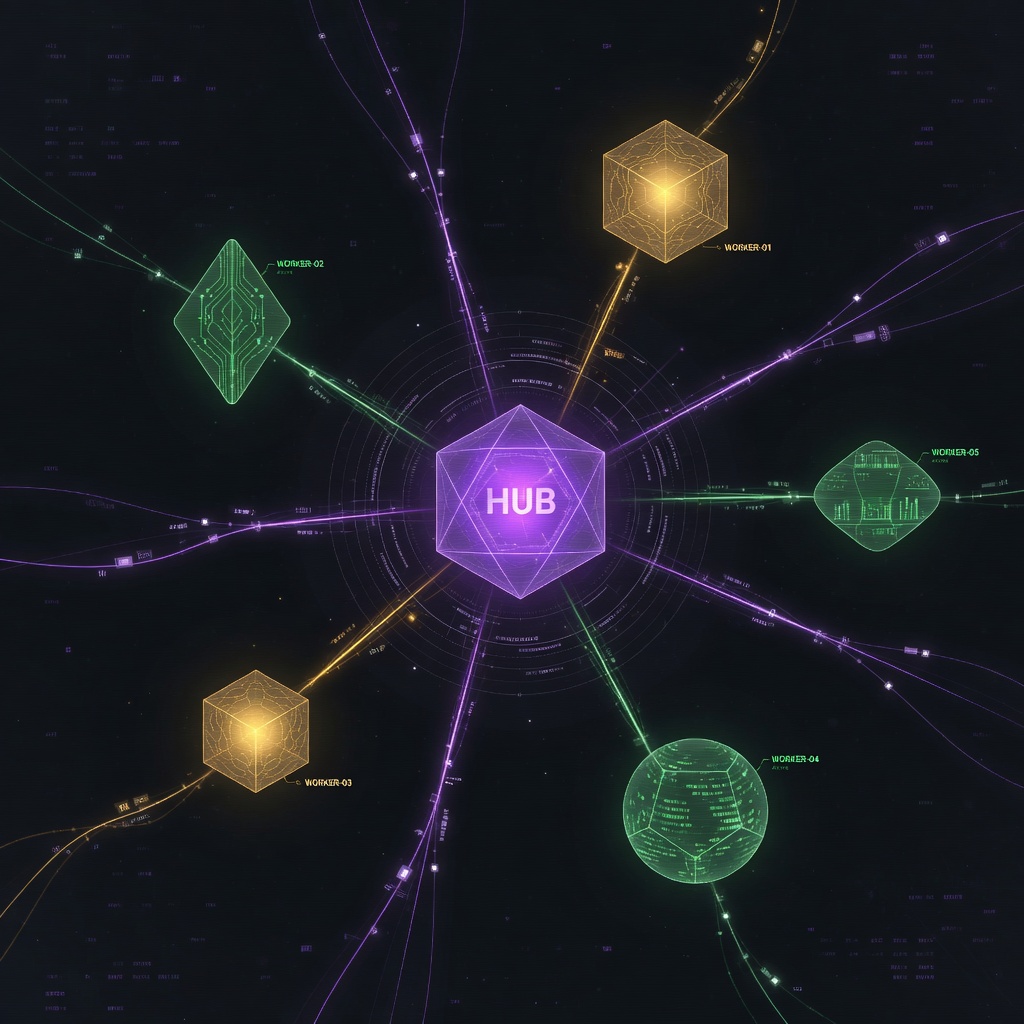
Claude, Grok, and Codex workers in a single mesh. Production code is reviewed by a three-model gate (Sentinel, Codex, and Grok in parallel) where all three must pass. A cost optimizer routes tasks across three Claude tiers (haiku for lightweight ops, sonnet for most work, opus for architecture and security) based on complexity signals in the prompt.
⚖
JEV Cost Intelligence
Every task is scored before it runs. Job Expected Value weighs estimated cost against predicted value, routing expensive prompts to cheaper models when confidence is high and reserving heavy compute for tasks that need it. Three confidence zones (dispatch, deadband, reject) prevent wasted spend automatically. The system learns from outcomes: each completed task refines the model's cost predictions for the next one.
📱
iMessage Bridge
Dispatch tasks from your phone by texting the hub. A Python daemon reads chat.db, routes through the hub, and replies via osascript. Natural-language commands also operate the entire fleet: trust levels, autonomy, kill switch, and memory consolidation all respond to plain-text chat. No cloud relay. No third-party service.
🔗
DAG Pipelines
Tasks declare dependencies forming execution graphs. Parent output flows into child prompts under explicit injection control: escaped, delimited, and author-authorized, so a compromised worker cannot steer downstream prompts. One API call chains research → summarize → notify.
🧠
Agent Memory
FTS5-indexed, Fernet-encrypted knowledge per agent. Extracted from task output and auto-injected into future prompts. MultiFernet key rotation re-encrypts the store to a new primary key without downtime or lost history. Twice-daily consolidation merges learnings across the fleet.
📊
UCB Reputation
Upper Confidence Bound scoring balances task success history against exploring underutilized nodes. Circuit breakers remove failing workers from rotation without manual intervention.
🔨
MCP Integration
Expose the entire mesh as callable tools inside Claude Code and Claude Desktop. Dispatch tasks, poll status, query memory, all without leaving your editor. An event-driven plugin system hooks external modules into task lifecycle events, with optional FCM push to registered mobile devices.
🔒
RBAC Auth
Role-based access with scoped API tokens and multi-user support. 25 permissions across 4 role presets. Zero-permission tokens denied by default. Per-agent tokens scoped to declared capabilities only.
🔑
Cryptographic Provenance
Every result signed with HMAC-SHA256. Multi-step pipelines form a signed receipt chain; on-demand verification at /api/tasks/{id}/provenance detects tampering at any point in the chain. Optional per-agent Ed25519 keys provide worker-attributable authorship.
📋
Daily Blog
The mesh writes its own blog post every day from real analytics. Task throughput, model performance, learnings from the last 24 hours, synthesized and published automatically. The fleet narrates itself.
🌐
Federation
Peer hub relay connects independent M3SHD instances into a federated mesh. Tasks route across hub boundaries with 3-hop loop prevention. Each hub retains sovereignty: federation is opt-in, not hierarchical.
🐝
Stigmergy
Ant Colony Optimization pheromone traces guide task routing without central planning. Workers deposit success signals that decay exponentially; the mesh learns which paths work by following the traces others leave behind.
🛑
Kill Switch
Three-mode emergency halt: graceful (finish current step and checkpoint), circuit-break (drain queues and hold new work), or hard-kill (stop immediately and capture forensic state). Engaged from dashboard, API, or iMessage. The mesh resumes exactly where it stopped.
🛡
Adaptive Defense
Four-tier threat posture (green, yellow, orange, red) with automated IP bans, rate limiting, and incident correlation. Threat events from workers feed a centralized response engine. Escalates autonomously, de-escalates on evidence.
👁
Theory of Mind
Three-layer belief system tracks what each agent knows, can do, and is working on. Routing decisions factor in not just load and capability, but the hub's model of each agent's current cognitive state and strategic alignment.
⚙️
Tool Forge
When no existing tool fits, the LLM writes one. Generated Python code is AST-validated and sandboxed with 5-second timeouts. Tools earn trust tiers (untrusted, trusted, verified) through successful execution history.
🔭
Fleet Watchdog
Rolling-window error rates and p95 latency per worker. Agents exceeding thresholds are automatically quarantined and probed for recovery. Mobile workers that lose connectivity hand off in-progress tasks; partial output is preserved and a continuation dispatched to the next available agent. SSE events stream all state changes in real time.
📝
Blackboard
Shared working memory for multi-agent collaboration. Agents post typed entries to named boards, trigger synthesis when enough evidence accumulates, and read each other's findings. TTL-based garbage collection keeps boards clean.
🔁
Recursive Self-Improvement
Gap detection identifies missing capabilities. The LLM generates new skills to close them, gated by four safety checks and a circuit breaker. An Actor-Curator bandit selects which gaps to close first. Goal inference generates new objectives from live mesh state and automatically tasks idle workers; the mesh decides what to do next.
🎤
Voice Dispatch
Siri Shortcuts are a first-class task source: voice:siri tasks enter the same dispatch pipeline as API and iMessage submissions (one-time webhook configuration on the hub). An ntfy push notification delivers the result to your phone when the worker finishes.
🔬
Metacognition
Every dispatched task carries a confidence instruction: agents report 0.0-1.0 self-scores. Results below 0.5 automatically trigger a verification task. The confidence score feeds the worker's UCB reputation weight and Theory of Mind beliefs.
🗣
Multi-Agent Deliberation
Three primitives for collective decisions. Debate fans eligible tasks to two independent agents and synthesizes their analyses with a third; voting reaches majority consensus using lightweight haiku-class agents. Adversarial review automatically dispatches a challenger when confidence falls below threshold. A second agent audits the result and flaws trigger a revision back to the original agent.